





NewsDetails
Welding Table Buyer Considerations: A Decision Framework for Manufacturers
author:jinchang time:2026-07-11 10:35:04 click:182
Purchasing a welding table is a capital investment that influences production capability, quality consistency, and operational flexibility for years. With options ranging from basic flat plates to fully modular 3D systems, and prices spanning from a few hundred to tens of thousands of dollars, making the right choice requires a structured evaluation process. This article outlines the critical welding table buyer considerations that manufacturing decision-makers should assess before committing to a purchase, organized into a practical decision framework.
Define Your Application Requirements First
Before evaluating any product specification, document your application requirements in detail. Key welding table buyer considerations at this stage include: the range of workpiece weights you need to support, the dimensional envelope of your largest and smallest parts, the number of different part configurations processed per month, required positional accuracy for your weldments, and whether your application involves manual welding, robotic welding, or both. This requirements document becomes the benchmark against which every product specification is compared. Purchasing teams that skip this step tend to over-specify (paying for capability they do not need) or under-specify (discovering limitations after the system is in production).
Load Capacity and Structural Rating
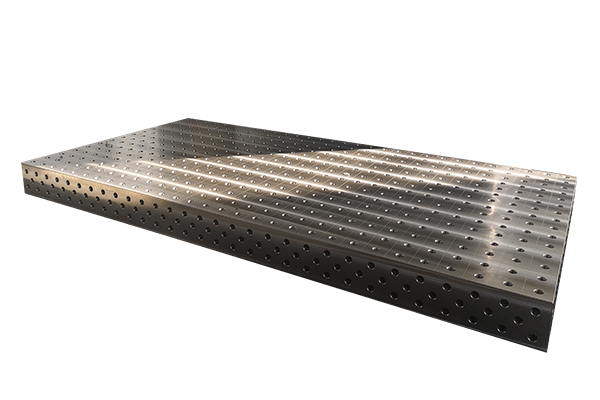
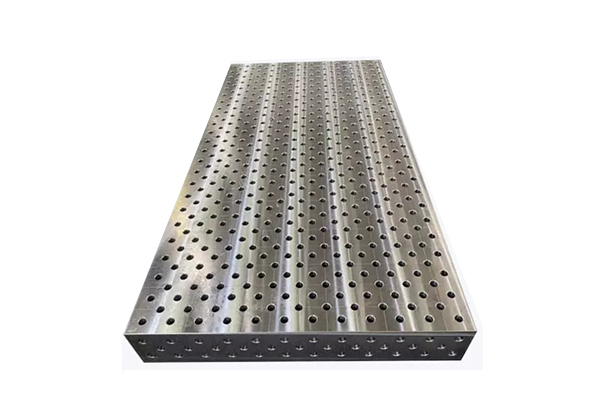
Load capacity is the most fundamental of all welding table buyer considerations. A table rated for 200 kg will deflect unacceptably under a 600 kg structural component, regardless of how precisely it was machined. Evaluate both static load capacity (workpiece weight) and dynamic load capacity (cutting or welding forces that multiply effective loads). For welding applications, dynamic forces from thermal expansion and contraction can add 50-100 percent to the static load. Always select a table with a rated capacity at least 1.5 times your maximum expected combined static and dynamic load. Request the manufacturer's load-deflection curve, not just a single maximum load number, to verify linear behavior across your operating range.
Flatness and Positional Accuracy Specifications
Flatness directly affects positional accuracy and weld quality. Standard welding table flatness specifications range from 0.05 mm per meter (precision grade) to 0.15 mm per meter (standard grade). For applications requiring positional accuracy of plus or minus 0.1 mm or tighter, precision-grade flatness is necessary. For general structural fabrication where tolerances are 0.5 mm or greater, standard grade provides adequate performance. Verify that the flatness specification applies to the entire working surface, not just a localized test area. Request individual calibration certificates rather than relying on generic catalog specifications.
Material Selection: Cast Iron vs. Steel vs. Aluminum
Material choice ranks among the most consequential welding table buyer considerations because it affects rigidity, thermal behavior, weight, and cost. Cast iron offers excellent vibration damping, thermal stability, and cost-per-unit-of-rigidity - making it the preferred choice for most welding applications. Steel provides the highest absolute stiffness and is suitable for extreme-load applications but has less favorable thermal characteristics. Aluminum is lightweight and portable but unsuitable for precision welding due to excessive deflection under load and poor thermal stability. For 90 percent of industrial welding applications, cast iron delivers the optimal balance of performance and cost.
Modular Capability and Clamping System Compatibility
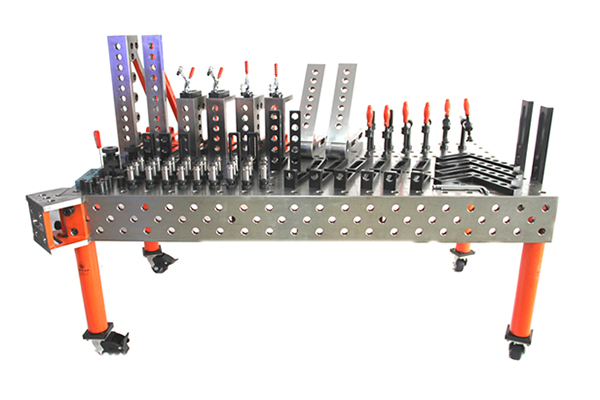
If your production involves multiple part configurations, modular capability is a critical welding table buyer consideration. Modular tables feature precision grid holes that accept locating pins, support posts, and clamping components, enabling rapid fixture configuration without custom tooling. Evaluate: the hole grid spacing (50 mm or 100 mm are standard), hole type (reamed for locating accuracy, threaded for direct clamping, or combination), the range and variety of available clamping components, and whether the clamping system is proprietary or compatible with industry-standard components. Proprietary systems lock you into a single supplier; standard-compatible systems offer broader sourcing flexibility and typically lower component costs.
Table Size and Workshop Layout Integration
A welding table that does not fit the workshop layout is a table that underperforms. Measure the available floor space including clearance for operator movement, material handling equipment (overhead cranes, forklifts), and welding fume extraction. Consider whether a single large table or multiple smaller tables better serve your workflow. Multiple smaller tables allow parallel operations and reduce changeover bottlenecks but require more total floor space. Also consider table height and leg design: some tables offer adjustable height for ergonomic welding positions, while others provide integrated storage beneath the working surface. These layout welding table buyer considerations affect daily productivity as much as any technical specification.
Total Cost of Ownership Beyond Purchase Price
The purchase price of a welding table represents only 40-60 percent of its total cost of ownership over a 10-year service life. Additional costs include: clamping component kits (typically 20-30 percent of the base table price), annual calibration and inspection (1-3 percent of table price), component replacement over time (5-10 percent of component kit price per year), and training for setup and maintenance (a one-time cost). When comparing suppliers, request a total cost of ownership estimate covering 5 years and 10 years. A lower-priced table that requires expensive proprietary clamping components or frequent calibration may cost more in the long run than a higher-priced system with standard components and stable calibration requirements.
FAQ: Welding Table Buyer Considerations
What is the most important specification to evaluate when buying a welding table?
Load capacity is the most critical because it is a pass/fail criterion - a table that deflects under your workpiece weight will not perform regardless of other specifications. Verify rated capacity against your maximum combined static and dynamic loads with a 1.5 times safety margin.
Is a modular welding table worth the premium over a basic flat table?
For operations running more than 5 different part configurations, yes. Modular tables eliminate the need for dedicated fixtures, reducing both tooling costs and changeover time. For single-part high-volume production, a basic flat table may suffice.
How do I verify manufacturer flatness claims?
Request an individual CMM calibration certificate for the specific table you will receive, not a generic specification. Upon receipt, verify flatness with a precision level or straight edge at minimum. For critical applications, commission an independent CMM inspection.
Should I choose a table with reamed or threaded holes?
Reamed holes provide superior locating accuracy (H7 tolerance) and are preferred for precision applications. Threaded holes offer direct clamping capability without separate nuts. Many manufacturers offer combination tables with both reamed and threaded holes, providing maximum flexibility.
What warranty coverage should I expect?
Reputable manufacturers offer 5-10 year warranties on base plates against manufacturing defects and 1-3 year warranties on components. Be cautious of manufacturers offering only 1-year warranties on base plates, as this may indicate limited confidence in material quality and stress relief processes.
Conclusion
Effective welding table buyer considerations extend far beyond comparing specification sheets. By systematically evaluating application requirements, load capacity, flatness, material selection, modular capability, workshop layout integration, and total cost of ownership, purchasing teams can select a system that delivers optimal performance and value over its entire service life. The investment in thorough evaluation upfront prevents costly mismatches and ensures that the selected welding table becomes a productive asset rather than an expensive limitation.
References
Bi, Z.M. and Zhang, W.J. (2001). Flexible fixture design and automation: Review and future directions. International Journal of Advanced Manufacturing Technology, 17(4), 266-277.
Rong, Y. and Bai, Y. (2000). Modular fixture element assembly and accuracy analysis. International Journal of Production Research, 38(14), 3103-3114.
Kumar, S. and Nee, A.Y.C. (1995). Development of a modular fixture design system. Journal of Intelligent Manufacturing, 6(4), 263-274.
Boerma, J.R. and Kals, H.J.J. (1989). FIXES, a system for automatic selection of set-up clamping elements. Annals of the CIRP, 38(1), 443-446.
 Recommended Products
 Contact Us
—— Hotline:+86 13833738896
—— Hotline:+86 17332777263
—— Email:gongliliangju@163.com
—— Whatsapp:+8615832706206
—— Whatsapp:+8615931710409
—— Address:Beihan Village, Haocun Town, Botou City, Cangzhou City, Hebei Province, China