





NewsDetails
High Precision Welding Platform Performance Guide
author:jinchang time:2026-05-17 22:42:16 click:166
High Precision Welding Platform Performance Optimization
A High Precision Welding Platform plays a critical role in ensuring welding accuracy, dimensional consistency, and production efficiency in modern industrial fabrication.
As industries demand tighter tolerances and more automated production systems, welding platforms must deliver exceptional rigidity, positioning repeatability, and operational stability.
Importance of Welding Precision
The performance of a High Precision Welding Platform directly affects final product quality. Inaccurate positioning or structural instability may lead to welding deformation, assembly deviation, and costly rework.
Industries such as aerospace, automotive, rail transit, and energy equipment manufacturing require highly accurate welding systems to maintain strict engineering standards.
Structural Rigidity Optimization
Structural rigidity is one of the most important factors influencing platform performance. A high-quality High Precision Welding Platform should resist thermal deformation and mechanical vibration during heavy-duty welding operations.
Optimization methods typically include:
Finite element structural analysis
Reinforced rib design
Stress-relief heat treatment
High-strength steel materials
Improved rigidity enhances long-term dimensional stability and positioning consistency.
Precision Positioning System
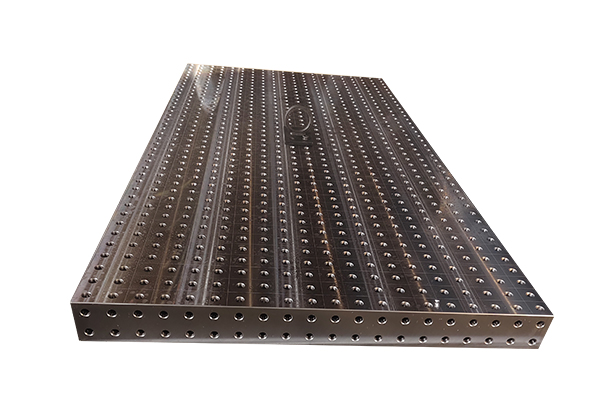
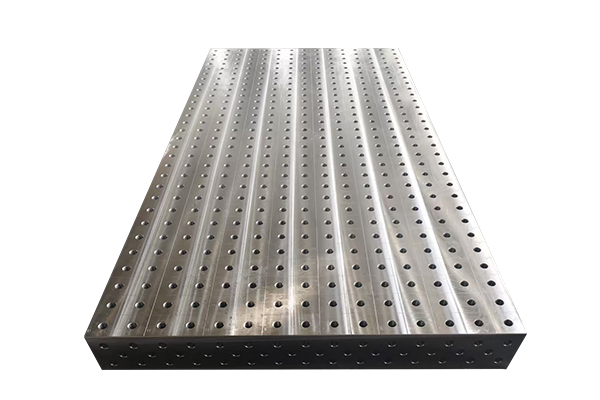
Positioning accuracy determines fixture repeatability and robotic welding reliability. Modern High Precision Welding Platform systems use precision hole grids and modular positioning components to maintain consistent assembly coordinates.
Advanced positioning systems improve:
Repeatability accuracy
Fixture interchangeability
Multi-station consistency
Automated welding precision
These advantages are especially valuable in robotic production lines.
Vibration and Thermal Control
Welding processes generate heat input and dynamic vibration, both of which can affect positioning accuracy.
A professional High Precision Welding Platform often incorporates vibration-damping structures and thermal management design to minimize dimensional variation during operation.
Reducing vibration improves weld quality while preventing premature fixture wear.
Surface Flatness and Machining Quality
Platform flatness directly affects workpiece alignment. Precision CNC machining ensures the welding surface maintains strict dimensional tolerances across large working areas.
High machining quality improves:
Fixture assembly precision
Welding consistency
Component interchangeability
Long-term wear resistance
Many manufacturers also apply anti-rust surface treatment to extend service life.
Automation Integration Capability
Modern manufacturing increasingly relies on robotic welding systems and digital production management. A High Precision Welding Platform should support seamless integration with:
Robotic welding arms
Positioners
Automated transfer systems
Laser measurement devices
Smart manufacturing software
Automation compatibility improves production speed and quality consistency.
Maintenance and Calibration
Routine calibration is essential for maintaining long-term High Precision Welding Platform performance. Periodic inspection helps identify wear, positioning deviation, or surface damage before quality issues occur.
Preventive maintenance typically includes:
Flatness verification
Hole accuracy inspection
Fixture alignment testing
Surface cleaning and lubrication
Proper maintenance significantly extends operational lifespan.
Conclusion
A High Precision Welding Platform is a key component in advanced industrial welding systems. Through structural optimization, precision machining, vibration control, and automation integration, manufacturers can achieve higher welding quality and more stable production performance.
As industrial fabrication continues evolving toward intelligent manufacturing, optimized welding platforms will remain essential for maintaining precision, efficiency, and long-term production reliability.
References
Kou, S. Welding Metallurgy
Cary, H. B. Modern Welding Technology
Robotic welding fixture optimization research (sciencedirect.com )
ISO 13920 Welding Tolerance Standards
Manufacturing fixture precision engineering studies
 Recommended Products
 Contact Us
—— Hotline:+86 13833738896
—— Hotline:+86 17332777263
—— Email:gongliliangju@163.com
—— Whatsapp:+8615832706206
—— Whatsapp:+8615931710409
—— Address:Beihan Village, Haocun Town, Botou City, Cangzhou City, Hebei Province, China