





NewsDetails
3D Flexible Welding Platform for Automotive Welding: Precision and Productivity
author:jinchang time:2026-06-08 19:44:50 click:81
Automotive manufacturing requires high precision in welding processes to ensure structural integrity, safety compliance, and production efficiency. Components such as chassis frames, subframes, and body panels must meet strict tolerance requirements while being produced at scale.
A 3D flexible welding platform provides a modular and reconfigurable fixturing system that allows manufacturers to position and secure complex components accurately in three-dimensional space. Compared to traditional fixed welding jigs, it significantly improves flexibility, reduces setup time, and lowers overall tooling costs.
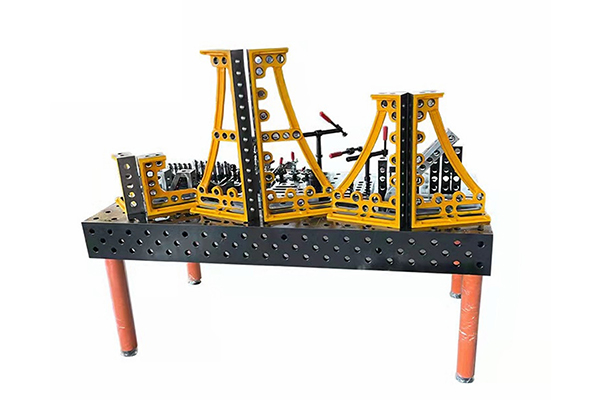
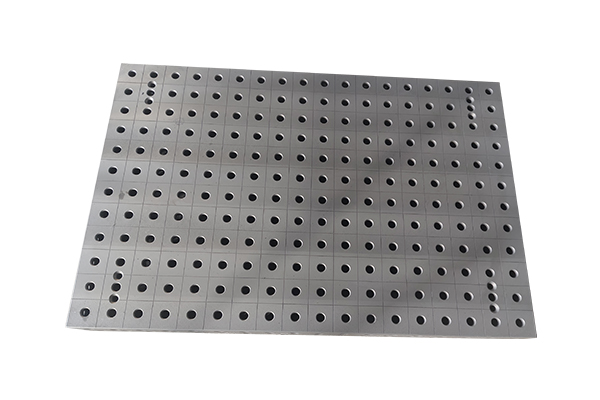
What Is a 3D Flexible Welding Platform
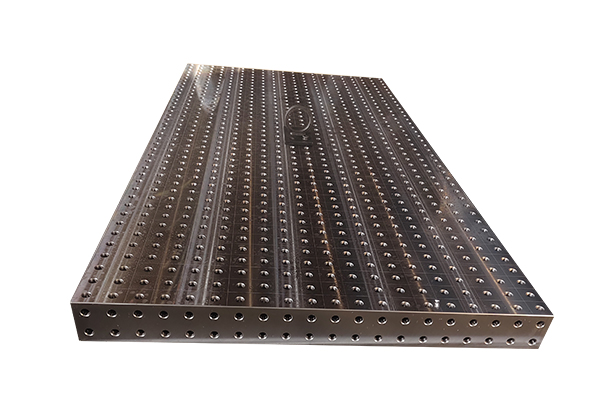
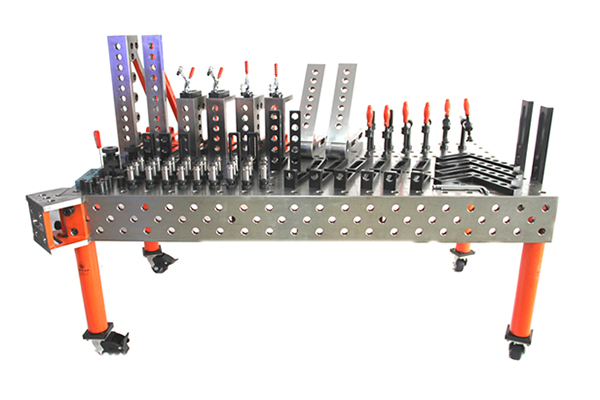
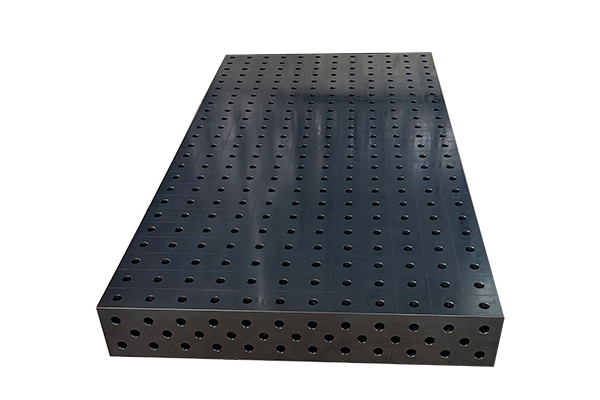
A 3D flexible welding platform is a modular workholding system designed for welding applications. It consists of a precision-machined base plate combined with adjustable fixtures, clamps, and positioning components.
Unlike conventional flat tables, it allows multi-axis positioning of workpieces, enabling operators to secure components at virtually any angle required for welding.
Why Automotive Welding Requires Flexible Fixturing
Automotive parts are structurally complex and often feature curved geometries, multi-angle joints, and irregular mounting points. Traditional welding fixtures are designed for single-purpose use and lack adaptability.
A flexible welding platform solves this by allowing:
Multi-angle positioning of parts
Adjustable support points for different geometries
Rapid reconfiguration between vehicle models
Improved accessibility for weld operations
This flexibility is especially important in modern automotive production, where model variations are frequent.
Advantages Over Traditional Welding Fixtures
Compared to dedicated welding jigs, a 3D flexible welding platform provides several operational advantages:
Eliminates the need for multiple custom fixtures
Reduces tooling investment costs significantly
Shortens setup and changeover time
Supports multiple part designs on one system
Improves production flexibility in mixed-model manufacturing
For many suppliers, a single modular system can replace dozens of dedicated fixtures.
Applications in Automotive Manufacturing
3D flexible welding platforms are widely used in:
Subframe and Chassis Assembly
They provide stable positioning for structural components that require precise alignment before welding.
Exhaust System Fabrication
Complex tubular geometries can be positioned accurately without custom jigs.
Body-in-White Components
Door frames, brackets, and structural reinforcements benefit from repeatable positioning.
Prototype Development
Ideal for low-volume or evolving designs where fixture changes are frequent.
Accuracy and Positioning Performance
Modern 3D flexible welding platforms are engineered for high repeatability and dimensional stability.
Typical performance includes:
Base plate flatness within 0.05 mm per meter
Positional repeatability around ±0.1 mm
High rigidity under welding heat loads
When combined with proper setup procedures, they provide sufficient accuracy for most automotive welding applications.
Reducing Welding Distortion
Welding distortion is a common issue caused by uneven heat distribution during fabrication. Flexible fixturing helps mitigate this problem by:
Applying balanced clamping forces
Positioning clamps near weld zones
Stabilizing components during thermal expansion
Using repeatable clamp pressure systems
This reduces rework rates and improves dimensional consistency across batches.
Integration Into Production Workflows
A structured workflow improves efficiency when using a 3D flexible welding platform:
Review part drawings and welding requirements
Configure base plate and fixtures
Set up and align workpiece
Verify positioning accuracy
Perform welding operations
Record fixture setup for future reuse
Reset platform for next job
This workflow enables repeatable production across multiple product lines.
FAQ
What is a 3D flexible welding platform used for?
It is used to position and hold automotive components during welding with high flexibility and accuracy.
Is it better than traditional welding jigs?
Yes, especially for multi-model production and low-to-medium volume manufacturing, where flexibility is critical.
What accuracy can it achieve?
Typically around ±0.1 mm depending on setup quality and fixture configuration.
Can it be used for robotic welding?
Yes, many systems are compatible with robotic welding cells and automated production lines.
What industries use it besides automotive?
It is also used in aerospace, machinery manufacturing, and metal fabrication industries.
Conclusion
A 3D flexible welding platform provides automotive manufacturers with a highly adaptable and cost-efficient fixturing solution. By replacing dedicated welding jigs with a modular system, it reduces tooling costs, improves production flexibility, and ensures consistent welding accuracy.
As automotive production shifts toward multi-model platforms and faster iteration cycles, flexible welding systems are becoming an essential part of modern fabrication workflows.
References
Bi, Z.M., Zhang, W.J. Flexible fixture design and automation. International Journal of Advanced Manufacturing Technology, 2001.
Chan, K.C., Lu, S.C.Y. Welding fixture design methods. Journal of Manufacturing Systems, 1998.
Masood, S.H., Soar, R.C. Modular fixture systems in manufacturing. International Journal of Production Research, 2003.
Wang, Y. et al. Welding distortion control techniques. Journal of Materials Processing Technology, 2019.
 Recommended Products
 Contact Us
—— Hotline:+86 13833738896
—— Hotline:+86 17332777263
—— Email:gongliliangju@163.com
—— Whatsapp:+8615832706206
—— Whatsapp:+8615931710409
—— Address:Beihan Village, Haocun Town, Botou City, Cangzhou City, Hebei Province, China